Dec 242009

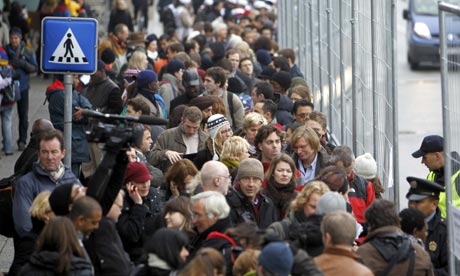
The Copenhagen UN climate conference ended last Saturday with a weak agreement, not the groundbreaking treaty many had hoped for. With more than 100 heads of governments and many more parliamentarians and dignitaries, COP-15 became the largest assembly of world leaders in diplomatic history. The Copenhagen conference had been planned out for two years in many small informal and large official meetings, following the 2007 Bali Action Plan in which nations had agreed to finalize a binding agreement this December. The outcome falls far short of this original goal. Delegates only “noted” an accord (“the Copenhagen Accord”) struck by the United States, Brazil, China, India, and South Africa that has two key components: first, it sets a target of limiting global warming to a maximum of 2 degrees Celsius over pre-industrial times; second, it proposes $100 billion in annual aid for developing nations starting in 2020 to help them reduce emissions and adapt to climate change.

2 degrees Celsius is seen by mainstream science as a threshold for dangerous climatic changes including sea-level rise and accelerated glacier melt, as well as more intense floods, droughts, and storms. Many scientists also believe that a majority of worldwide ecosystems will struggle to adapt to a warming above that mark, and more recently have set the threshold even lower, at 1.5 degrees Celsius. The accord, however, lacks any information on how this goal of preventing “dangerous” climate change, which had already been set by the 1992 United Nations Framework Convention, would be achieved. It is generally assumed that in order to keep global warming below 2 degrees, worldwide emissions have to

Apr 022009

from CCAP Newsletter 

On March 18, 2009, Alexander Ochs, CCAP’s director of international policy, discussed “Views on Carbon Offsetting in the United States” at Point Carbon’s Carbon Market Insights Conference in Copenhagen, Denmark.“International offsets like the Clean Development Mechanism (CDM) and domestic offsets will likely play an important role in any future U.S. cap and trade program,” Ochs told delegates from around the world. “However, it is important to understand that offsets are only one mechanism that U.S. lawmakers are currently considering in their effort to contain the cost of a federal carbon market. There is also a certain contradiction in the debate between lowering the cost of mitigating emissions on the one hand, and not wanting to send money oversees to make our competitors’ economies more efficient.”Ochs agreed with co-panelist Peter Zapfel from the European Commission that the CDM alone is not sufficient for reducing rapidly growing greenhouse gas emissions in the developing world. “Major emitters like the developing countries China and Mexico must contribute more to the solution than simply offsetting reduction commitments made elsewhere — and they are willing to do so,” Ochs said. “Sectoral commitments for energy-intense industries are the next important step on the staircase to a full integration of these countries into the global carbon market.”

You can find my presentation here: ochs-futureofoffsetsinus_carbonmarketinsights2009.pdf

Mar 292009

On March 25, at a workshop in Santiago, Chile, I presented our research teams’ results on Mexico and Brazil as part of CCAP’s Developing Country Project. We held the workshop at the headquarters of the Economic Commission for Latin America and the Caribbean (also a co-host of the event). Officials from seven South American nations attended the workshop, gathering to discuss the status of the international climate change negotiations and to hear about the climate-related research CCAP teams in Mexico and Brazil had conducted. The topics of discussion included:

• Nationally appropriate mitigation actions, a key feature of the Bali Roadmap;
• Analysis of GHG mitigation options in Brazil’s forestry sector;
• The GHG and other implications of expanding the production of biofuels, both ethanol and biodiesel, in Brazil; and
• Lessons learned from a first attempt to propose sectoral goals for GHG emissions in Mexico’s cement and oil refining industries.
The participants expressed a strong interest in seeing this work continue and for the project to expand into other countries, such as Chile and Argentina. The CCAP Developing Country Project is funded by the UK Department for Foreign Investment and Development (UK DFID), the William and Flora Hewlett Foundation and the Tinker Foundation.

Please find my introduction here: ochs-chiledfidworkshopintro_090325.pdf
and my presentation on NAMAs and the Global Deal on Climate Change here: ochs-chilenamatheglobaldealoncc_090525.pdf

Mar 242009
GHG Mitigation Opportunities in Brazil and Mexico
ECLAC, Santiago, Chile
March 25, 2009

Presentation given at ECLAC, Santiago, Chile on March 25, 2009

INTRODUCTION TO WORKSHOP

- Center for Clean Air Policy (CCAP)
- Assisting Developing Country Climate Negotiators through Analysis & Dialogue
- Workshop overview: GHG Mitigation Opportunities in Brazil and Mexico

NAMAS AND THE GLOBAL DEAL ON CLIMATE CHANGE
- Overarching goals and status quo
- Emissions
- Overview of International Climate Negotiations
- Developing countries are already doing more than many believe
- International Policy Context
- NAMA Requirements
- How financing could work
- Technology Finance
- Technology Finance Assistance to Encourage Stronger Actions
- Sources for Technology Finance
- China
- Mexico
- South Africa & South Korea
- Chile
- Brazil
- Sectoral Approach
- NAMAs and Sectoral
- Conclusions

[Please find presentation here on ECLAC website]

May 092008


Die wissenschaftliche Beweislage zum Klimawandel ist erdrückend. Erste Auswirkungen sind weltweit spürbar. Dass der Mensch die Hauptschuld an der Klimaveränderung trägt, steht dabei außer Frage. Die Verbrennung fossiler Energien, die Abholzung großer Waldgebiete sowie bestimmte landwirtschaftliche und industrielle Verfahren setzen Emissionen frei, die den natürlichen Treibhauseffekt der Erde immer weiter verstärken. Gelingt es nicht, die großen Volkswirtschaften zu reformieren – und dazu ist in den Worten des Bundesumweltministers nicht weniger nötig als eine „dritte industrielle Revolution“ – drohen im besten Fall unwirtlichere Lebensbedingungen, im schlimmsten eine Katastrophe kaum mehr kontrollierbaren Ausmaßes. Für die Problembekämpfung wird neben den Großemittenten des Nordens das Verhalten einiger zentraler Akteure der südlichen Erdhalbkugel maßgeblich sein: Bekommen China, Indien und Mexiko ihre explosionsartig steigenden Emissionen in den Griff? Wird der Waldschutz in Brasilien und Indonesien seinen notwendigen Beitrag zum globalen Klimaschutz leisten? Können Südafrika und Südkorea ihre fast vollständig auf fossilen Trägern basierende Energiegewinnung reformieren? Und wird die Blockademacht Australien künftig den ihr angemessenen Verantwortungsteil leisten? Die Bundesrepublik hat sich in den letzten Jahren als Lokomotive der internationalen Klimadiplomatie etabliert. Ein klimapolitischer Dialog Deutschlands mit wirtschaftlich und politisch aufstrebenden Staaten des Südens wäre einer Fortsetzung dieser Führungsrolle in einem immer wichtiger werdenden Politikfeld und damit der Profilbildung als Weltordnungspolitik mitgestaltende Mittelmacht äußerst dienlich. Im Erfolgsfall – wenn es also gelingt, neue Nord-Süd-Koalitionen im Klimabereich zu schmieden – könnte ein lang ersehnter Durchbruch in der globalen Klimagovernance gelingen.

BUCHKAPITEL in Günther Maihold/Stefan Mair (Hg.), Kooperation Deutschlands mit Führungsmächten des Südens, SWP/Nomos: September 2008

VORVERSION ALS SWP DISKUSSIONSPAPIER